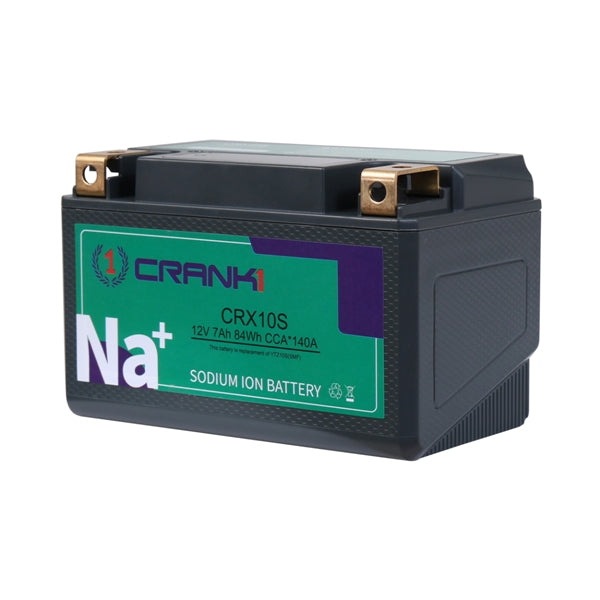
Battery For Yamaha YZF R1 (2004-2014) - CRX10S - Sodium-Ion - Factory Activated


Order Before 3pm for same day dispatch!
Please verify the correct battery model before placing order. Actual model name, dimensions & specifications are given in description. These images are actual and data is as per online availability. You may confirm with your workshop/mechanic also for fitment.
Price:
Sale priceRs. 13,700.00

Type: SMF (Sealed Maintenance Free) – Sodium-Ion

Dimensions:
Length: 150 mm
Width: 87 mm
Height: 93 mm

Capacity: 12 Volt
Amperes: 7 AH (10 HR)
CCA (Cold Cranking Amps): 140 A
Weight: 1.380 kg


CRANK1

Next-Gen Motorcycle Battery

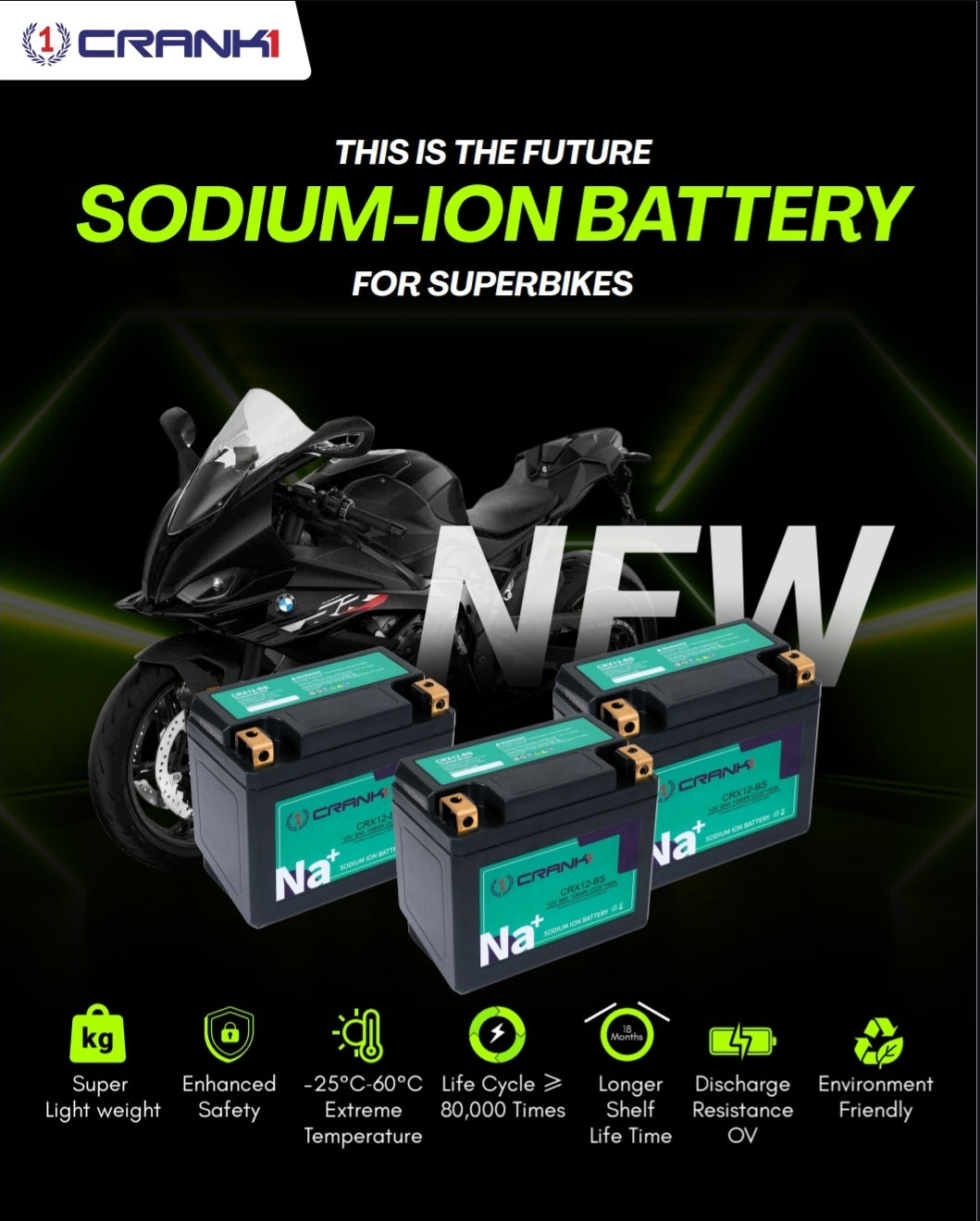
SODIUM-ION INNOVATION: A New Future for Motorcycles

Nowadays, there are various types of batteries available on the market — from lead-acid batteries to lithium-ion batteries — each with its own strengths and weaknesses depending on the application. These limitations have led researchers and manufacturers to explore new battery technologies that can match or surpass the performance of existing solutions while addressing their drawbacks.

Revolutionizing the battery industry, the CRANK1 Sodium-Ion battery stands out as a powerful, affordable, and eco-friendly alternative.


What Is a CRANK1 Sodium-Ion Battery?

The CRANK1 Sodium-Ion (Na-ion) battery is a type of rechargeable battery that works similarly to a lithium-ion battery, but instead of lithium, it uses sodium (Na) as the primary material to store and release energy.

Sodium is naturally abundant, low-cost, and widely available—making it a promising option for large-scale battery production without relying on rare or expensive metals.


Why CRANK1 Sodium-Ion Battery Is the Perfect Choice for Motorcycles

Motorcycles require lighter and more compact power sources—and CRANK1 Sodium-Ion batteries rise to the challenge with ease. Here’s what makes them the smarter choice:

2-year warranty & expected lifespan of up to or more than 5 years
Super lightweight: 2× lighter than lead-acid batteries
Zero maintenance
OEM sizing ensures 100% accurate fitment
Safer chemistry: Reduced risk of fire or explosion
High thermal stability: Performs reliably in extreme temperatures (-25°C to 60°C)
Longer cycle life: Capable of over 2,000+ charge/discharge cycles
Longer shelf life: Maintains performance even after long periods of inactivity
Environmentally friendly: No cobalt, nickel, or rare earth metals


Key Features of CRANK1 Sodium-Ion Battery

Safe, long-lasting, eco-friendly, and engineered to perform across a wide temperature range.


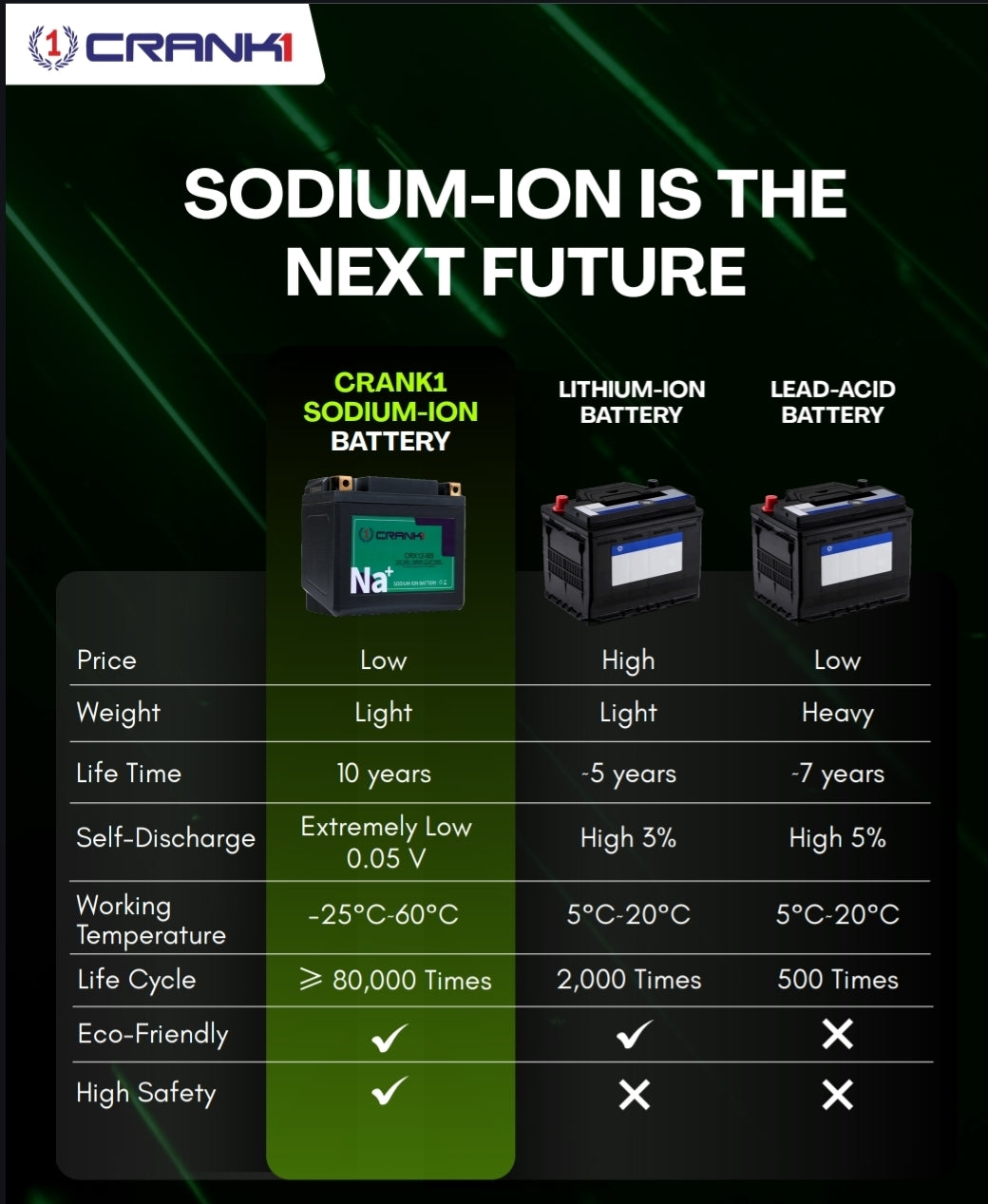
Sodium-Ion vs Other Battery Types

Sodium-ion batteries offer a strong balance of operating temperature tolerance, lightweight construction, long lifespan, and enhanced safety when compared to lithium-ion and lead-acid batteries.


Conclusion

The sodium-ion battery is emerging as a game-changing innovation for motorcycles. With its lightweight design, long lifespan, excellent safety profile, and strong performance in extreme temperatures, it checks all the boxes for modern two-wheel mobility.

Not only does it provide a more sustainable and cost-effective alternative to traditional battery types, but it also delivers consistent power—even after long periods of non-use.

CRX10S is replacement of YTZ10S

APPLICATIONS YEAR
 Yamaha YZF R1 2004-2014
 Kawasaki  ZX6R 2019-2025
 Honda Cbr 1000RR 2004-2007
 Benelli TNT 600 GT 2010-2025
 Benelli TNT 600i 2010-2025
 Triumph Street Triple 675 2010-2025
 Kawasaki Ninja 1000 2010-2025
 BMW S1000RR 2010-2025
 Honda Cbr 650 2010-2025
 Kawasaki  ZX10R 2011-2025
Yamaha YZF R6 2010-2025
Kawasaki Ninja H2R 2010-2025
BMW S1000XR 2010-2025
Aprilia RSV4 1000CC 2010-2025
Kawasaki Vulcan 650 2010-2025
Kawasaki Z800 2017-2025
Kawasaki Z900 2017-2025
Kawasaki Z650 2017-2025
Triumph Daytona 675 2010-2025
Honda Cbr 650R 2010-2025
Aprilia RSV4 R 2009-2016
BMW HP4 2013 Onwards
BMW 1000RR 2010-2025
BMW 1000RX 2010-2025
Honda CB1000 R 2009-2025
Honda CB650R 2019-2025
Honda CB650F 2014-2025
Husqvarna 701 Enduro Supermoto 2016-2020
Husqvarna 701Vitpilen, Svartpilen 2018-2021
Kawasaki Ninja 650 Abs 2017-2025
Kawasaki ZH2 2022-2025
MV Agusta Brutale 800CC 2016-2020
MV Agusta Brutale 910CC 2006-2009
MV Agusta Brutale 1078 RR, 1090 2009-2016
MV Agusta Brutale F3, 675CC 2016-2020
MV Agusta F4 1000CC 2005-2016
MV Agusta F4 Brutale 750CC 2000-2008
Suzuki GSX-R1000, Z, AL8 2017-2025
Kawasaki Versys 1000 -
 Honda Cbr 650F -
 Honda Transalp 750CC -
Yamaha R1 2010-2018
Honda Cbr 954RR Fireblade -

FAQ: Frequently Asked Questions 1. What are CRANK1 SODIUM-ION BATTERIES, and how do they different from lithium-ion batteries? Answer: Sodium-ion batteries use sodium ions to store and release energy, whereas lithium-ion batteries rely on lithium ions. Sodium is far more abundant and easier to source than lithium, making sodium-ion batteries potentially more sustainable and cost-effective. While lithium-ion batteries currently lead in energy density, sodium-ion tech has improved to offer competitive performance, particularly for applications like motorcycles where safety and cost matter greatly. 2. Why choose CRANK1 SODIUM-ION BATTERIES for motorcycles? Answer: Sodium-ion batteries provide several benefits for motorcycles including lighter weight (about one-third the weight of traditional lead-acid batteries), faster charging, longer lifecycle (up to twice the lifespan of lead-acid batteries), and enhanced safety due to integrated Battery Management Systems (BMS) managing voltage and preventing issues like overheating or voltage spikes. 3. Are CRANK1 SODIUM-ION BATTERIES safe to use on motorcycles? Answer: Yes, CRANK1 SODIUM-ION BATTERIES, include Advanced BMS technology that actively manages battery voltage and temperature. Their design also allows them to be mounted in any position without leakage risk, making them very safe and flexible for various motorcycle builds. 4. Are CRANK1 SODIUM-ION BATTERIES more environmentally friendly than lithium-ion or lead-acid batteries? Answer: Yes. Because sodium is widely available and can be sourced more sustainably than lithium, sodium-ion batteries tend to have a lower environmental impact. They avoid some of the resource constraints and ethical concerns tied to lithium mining. Additionally, longer battery lifespans contribute to less waste over time.

Related Products

You may also like